ServicesDrywall Repair
Drywall Repair in Garden City
We repair water-damaged, cracked and broken drywall in your home, from a single split seam to a ceiling section that sagged after a leak. Before we cut anything, we photograph and measure the damage, so you have a clear record if you decide to file an insurance claim.
When a full drywall repair makes sense
Drywall is a gypsum core sandwiched between sheets of paper. Dents and small holes are easy for it to absorb, but water and movement wear it down in ways a fast patch can't solve. A wet core turns soft, the face paper may peel away, and the board can droop between screws or framing. A crack that keeps reappearing is usually a sign of a badly taped joint or a stud that has moved.
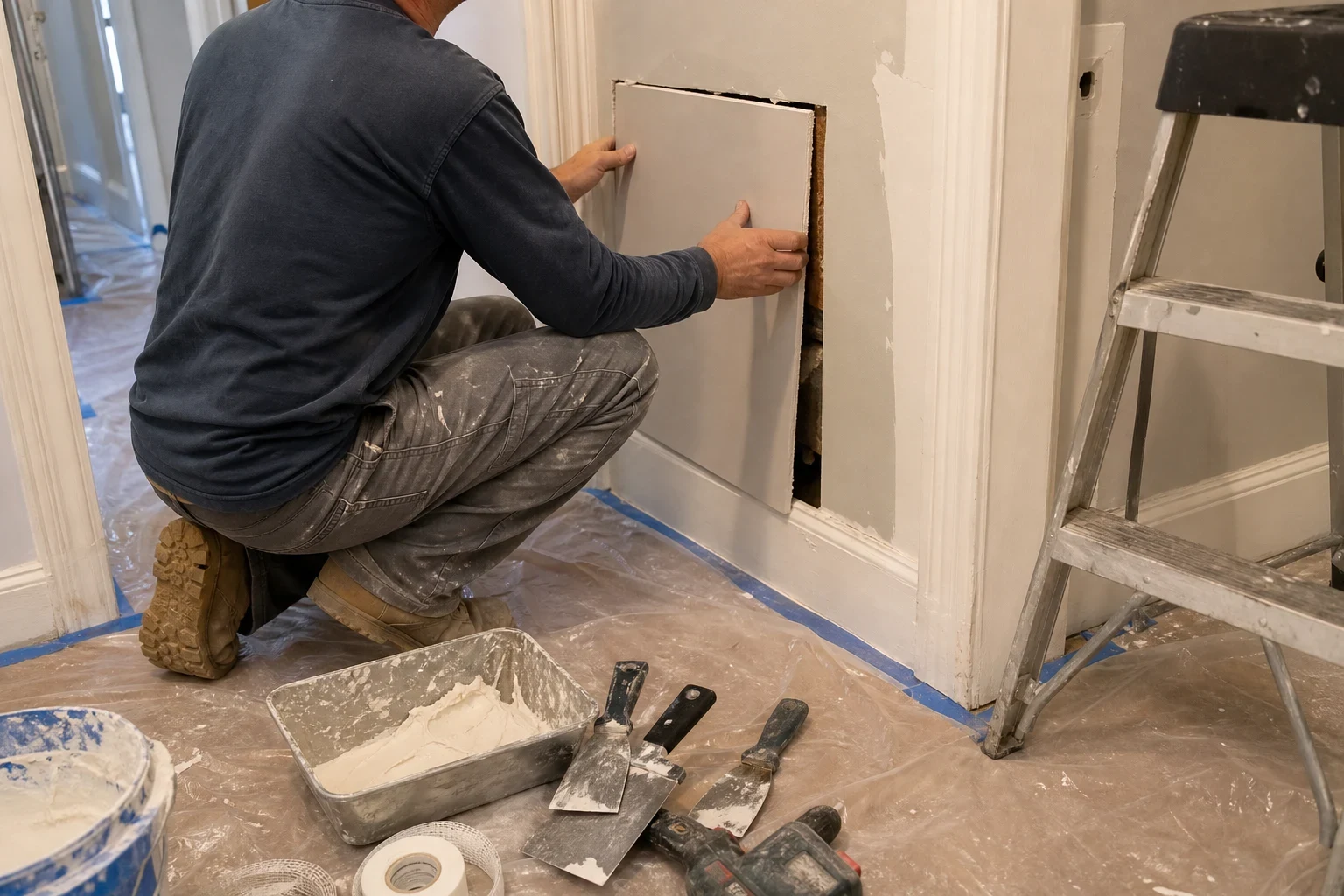
Of the services on this site, drywall repair is the bigger job. We open up the wall or ceiling, see how far the damage reaches, replace the failed material and finish it to blend with the surrounding surface. For a doorknob hole or a few anchor holes, see our drywall patching page instead.
We document what we uncover along the way. Photos of soaked insulation, stained framing and where the damage stops let you and your adjuster work from the same facts.
What the repair includes
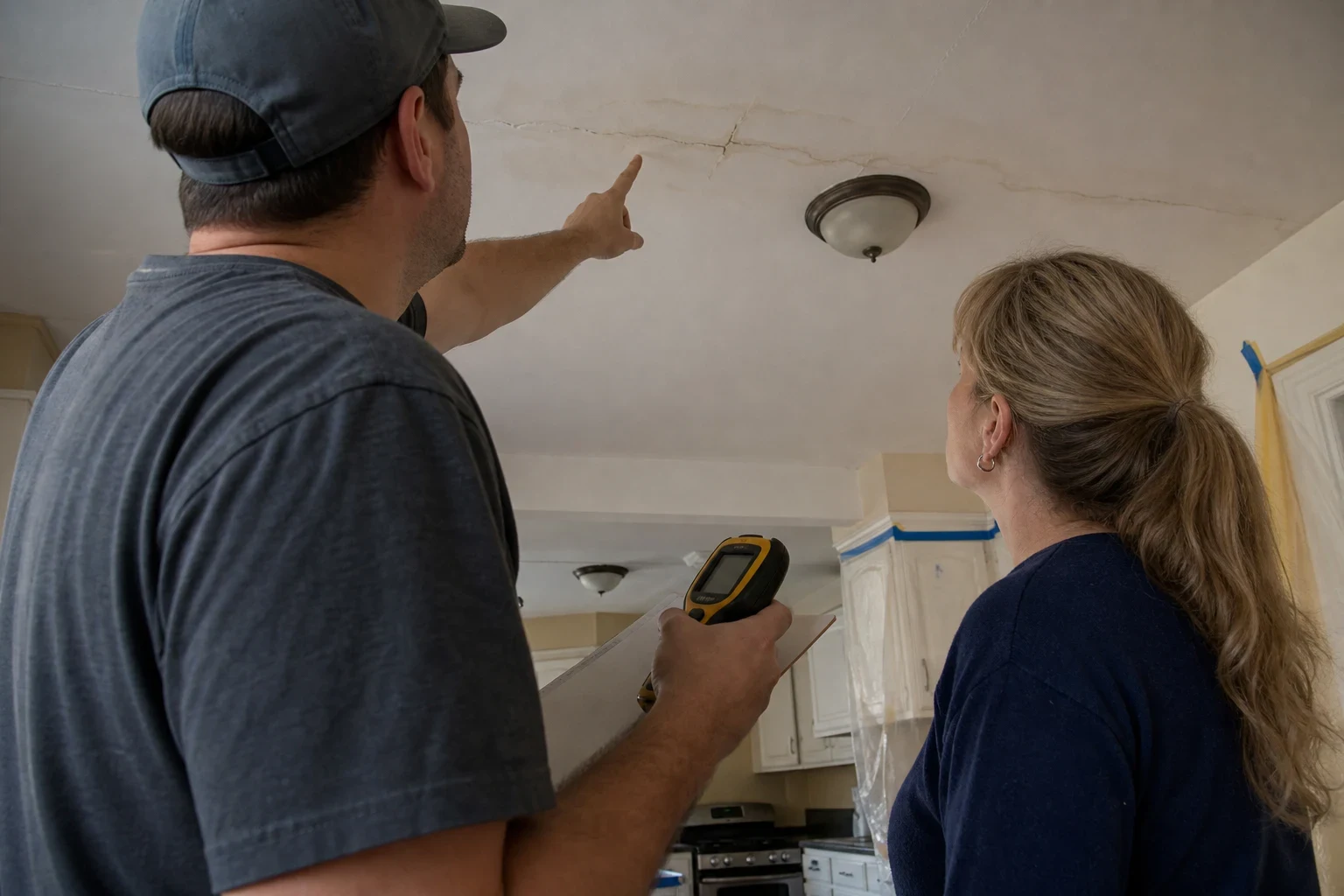
Moisture check before cutting
We use a moisture meter to map where the board is still wet. That reading decides where we cut, so we are not closing up damp gypsum that will stain again or grow mold behind the new paint.
Cutting back to sound board
Damaged drywall is cut out in a clean rectangle that ends on solid material, often on framing so the new piece has something to fasten to. Where the cut falls between studs, we add wood backing.
New board, tape and compound
We install drywall of the same thickness, usually 1/2 inch on walls and 1/2 or 5/8 inch on ceilings, so the surface stays flush. Joints get paper or mesh tape and several coats of compound, feathered wide so the repair does not show as a bump.
Texture matching
Smooth walls are sanded flat. If your ceiling or walls have a knockdown, orange peel or hand-troweled texture, we match the pattern on the repaired area before priming.
Primer and paint touch-up
Bare compound absorbs paint differently than painted board, so we prime it first. We then do a paint touch-up on the repair, carried to a natural break such as a corner where needed.
A clean work area
We lay drop cloths, seal off the room with plastic when we sand, and vacuum dust before we leave.
Signs your drywall needs more than a patch
- Brown rings or yellow stains
- A stain on a ceiling or wall means water reached the board. Even after it dries, the paper may be weakened and the stain will bleed through ordinary paint.
- Sagging or soft spots
- Press gently. If the board gives or bows between fasteners, the gypsum core has lost strength and needs replacing, not covering.
- Cracks that return
- Seasonal heating and humidity move framing in older Long Island homes, and a poorly taped seam will crack again after every winter. The fix is to open the joint and retape it.
- Bubbling tape or peeling paper
- Lifted joint tape usually means the compound under it never gripped the paper, or moisture worked its way in. The loose tape has to be cut out and set again in fresh compound.
- Rows of nail pops
- One pop is cosmetic. A line of them can mean the board is pulling away from the framing and should be refastened with screws.
How a repair moves along
- 1
Look, measure and photograph
Before any cutting, we check the damage, meter it for moisture and photograph every part of it. The written estimate you get lists the square footage and each step on its own line.
- 2
Protect the space and open up
We cover your floors and furniture, then take out the drywall that failed. Anything we find inside, such as soaked insulation or stained framing, gets photographed and shown to you.
- 3
Rebuild one coat at a time
New board goes up and the first coats of compound go on. Every coat has to harden completely before the next, so most repairs take two or three visits, depending on how big the area is and how humid the house is.
- 4
Final finish and cleanup
Sanding, texture matching, primer and a paint touch-up come next. Then we clean the room and walk you through the finished repair.
What sets the price of a drywall repair
The price depends on how much board gets replaced and how much finishing it takes to hide the repair. You get a written estimate once we have seen the damage, and if the open wall reveals more than we expected, we pause and show you before continuing.
- How big and where
- A small area on a wall costs less than a piece of ceiling. Working overhead takes ladders or staging and finishing goes slower.
- Damage you can't see yet
- Soaked insulation, damaged framing or water that ran along a joist can only be fully sized up after the board is opened.
- Texture and level of finish
- A knockdown or hand-troweled texture takes longer to match than sanding a smooth wall. Rooms with strong light from the side may call for a higher finish level so the repair doesn't cast shadows.
- How many trips
- Every compound coat needs time to dry. Bigger repairs and muggy weather mean more visits, and more visits raise the cost.
Drywall repair questions
- Will my insurance pay for the repair?
- We can't tell you that, because coverage is decided by your policy and your adjuster. What we can do is give you dated photos, moisture readings and a written line-item estimate that describes the cause and extent of the damage. Many policies treat sudden water damage differently from slow, long-term leaks, so ask your carrier how yours reads.
- Should I wait for the adjuster before you start?
- In most cases, yes, or at least check with your insurer first. We can document the damage in advance and leave the wall closed until you have the go-ahead. If wet material needs to come out sooner, we photograph everything before and after removal.
- Do you fix the leak that caused the damage?
- No. The source has to be repaired by the right trade before we close up the wall, or the new drywall will fail the same way. We confirm with a moisture meter that the area has dried before we hang new board.
- What if you find mold behind the drywall?
- We stop work and show you what we found, with photos. Small amounts on drywall we are already removing come out with the board. Anything more extensive needs a specialist, and we will tell you plainly rather than cover it up.
- Will the repair show after it's painted?
- Done properly, it shouldn't. We feather the compound well past the cut, match your texture, and prime before the paint touch-up. Old paint can fade, so we carry the touch-up to a corner or edge when a spot blend would stand out.
Get the damage documented and repaired
Tell us what you are seeing, where it is and when it started. We will set a time to inspect, take photos and give you a written estimate.